


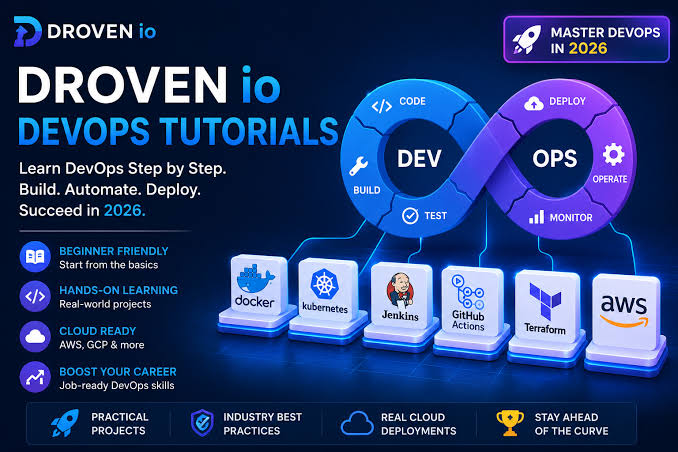
The demand for DevOps professionals has grown rapidly over the last few years. Companies want to build software faster, release updates more often, and keep their applications running without interruptions. Because of this, more people are looking for reliable learning resources that explain DevOps in a simple and practical way. One topic that has gained attention is Droven.io DevOps tutorials, especially among beginners who want an easy starting point without feeling overwhelmed by technical terms.
Learning DevOps can seem difficult at first because it combines software development, system administration, cloud computing, automation, and monitoring into one workflow. However, when these concepts are explained step by step with real examples, they become much easier to understand. Droven.io DevOps tutorials aim to simplify this learning process by introducing important topics one at a time, allowing learners to build confidence while gaining practical skills that are useful in real-world projects.
Instead of memorizing commands or tools, the goal of DevOps learning is to understand how modern software is built, tested, deployed, and maintained. Once you understand this process, learning tools such as Docker, Kubernetes, Jenkins, Terraform, or Git becomes much more meaningful because you know why each tool is used and how it fits into the complete DevOps lifecycle.
Whether you are a student planning your first technology career, a software developer wanting to improve deployment skills, a system administrator moving toward cloud technologies, or simply someone curious about automation, this guide is designed for you. Every section explains the concepts in simple language while gradually introducing more advanced ideas as your knowledge grows.
“DevOps is not just about learning tools. It is about creating a faster, smarter, and more reliable way to build software through teamwork and automation.”
In this complete guide, you will discover what Droven.io DevOps tutorials are, what topics they cover, which tools you should learn first, and how to build a structured roadmap that prepares you for today’s DevOps jobs. Along the way, you will also learn practical tips, common mistakes to avoid, and industry best practices that can help you become a confident DevOps professional.
This guide has been written in easy-to-understand language, making it suitable for readers with little or no previous experience. By the end of the article, you will have a clear understanding of how DevOps works and how Droven.io DevOps tutorials can support your learning journey from beginner to advanced.
What Are Droven.io DevOps Tutorials?
Droven.io DevOps tutorials are educational resources that help learners understand how DevOps works in real software development. They explain important topics such as automation, version control, cloud platforms, containers, CI/CD pipelines, and monitoring in a way that is easier to follow than reading technical documentation alone. Whether someone is completely new to DevOps or already has some experience, these tutorials can provide a structured learning path.
One of the biggest reasons people search for Droven.io DevOps tutorials is that DevOps is a broad field. Instead of learning random tools one by one, learners can understand how everything connects. Modern software development is no longer just about writing code. Teams also need to test, deploy, monitor, and improve applications continuously. A good tutorial series helps learners see the complete picture rather than focusing on only one technology.
| Feature | Details |
|---|---|
| Learning Level | Beginner to Intermediate |
| Main Focus | DevOps concepts and practical workflows |
| Best For | Students, Developers, IT Professionals |
| Learning Style | Step-by-step explanations with practical examples |
| Main Topics | CI/CD, Docker, Kubernetes, Cloud, Git, Automation |
| Goal | Build practical DevOps skills for real projects |
DevOps Fundamentals You Will Learn
Before using any DevOps tool, it is important to understand the ideas behind DevOps. Many beginners make the mistake of learning commands without knowing why those commands are used. A strong foundation makes learning advanced technologies much easier and helps you solve real problems instead of simply following tutorials.
At its heart, DevOps is a way for development and operations teams to work together. Developers create software, while operations teams make sure it runs smoothly in production. DevOps brings these responsibilities closer together by encouraging communication, automation, and continuous improvement. This approach helps companies release software faster while reducing errors and improving reliability.
Some of the core concepts you will learn include:
- Version Control using Git
- Continuous Integration (CI)
- Continuous Delivery (CD)
- Infrastructure as Code (IaC)
- Automation
- Containerization
- Cloud Computing
- Monitoring and Logging
- Security in DevOps (DevSecOps)
Instead of treating these topics as separate skills, DevOps connects them into one smooth workflow where software moves from development to production with minimal manual work.
Complete DevOps Learning Roadmap Using Droven.io DevOps Tutorials
Learning DevOps is much easier when you follow the right order. Many people become confused because they jump directly into Kubernetes or Terraform without understanding Linux or Git. A structured roadmap helps you build knowledge step by step while avoiding unnecessary frustration.
A beginner-friendly roadmap usually starts with learning the operating system and version control before moving into automation, containers, cloud services, and orchestration. Each skill supports the next one, making the learning process much more natural and effective.
| Step | Skill | Why It Matters |
|---|---|---|
| 1 | Linux Basics | Foundation of most servers |
| 2 | Git & GitHub | Version control and collaboration |
| 3 | Bash & Python | Automation and scripting |
| 4 | Cloud Computing | Deploy applications online |
| 5 | Docker | Create portable applications |
| 6 | Kubernetes | Manage containers efficiently |
| 7 | CI/CD Pipelines | Automate testing and deployment |
| 8 | Terraform | Infrastructure as Code |
| 9 | Monitoring Tools | Track application performance |
| 10 | DevSecOps | Build secure deployment pipelines |
Following this roadmap helps learners understand not only individual technologies but also how they work together in modern software development.
Essential DevOps Tools Covered in Droven.io DevOps Tutorials
Modern DevOps depends on many powerful tools that automate different stages of software delivery. Each tool solves a specific problem, but together they create an efficient workflow that reduces manual work and improves software quality. Understanding the purpose of each tool is more important than memorizing every command.
Some tools focus on source code management, while others handle deployment, infrastructure, monitoring, or container orchestration. Learning them gradually makes the process much less overwhelming and helps learners build practical experience through real projects.
Some of the most important DevOps tools include:
- Git for version control
- GitHub for collaboration
- Docker for containerization
- Kubernetes for container orchestration
- Jenkins for CI/CD automation
- Terraform for infrastructure management
- Ansible for configuration management
- Prometheus for monitoring
- Grafana for visualization
- Helm for Kubernetes package management
- GitHub Actions for automated workflows
- Azure DevOps for project management and pipelines
As technology continues to evolve, new tools appear regularly. However, understanding these core platforms provides a strong foundation that makes learning additional technologies much easier.
Benefits, Challenges, and Career Opportunities
Learning through Droven.io DevOps tutorials offers many advantages because DevOps skills are useful across almost every technology company. Businesses want faster software releases, fewer deployment failures, and better collaboration between teams. As a result, professionals with DevOps knowledge are in high demand across industries including finance, healthcare, e-commerce, gaming, and cloud services.
Although DevOps is rewarding, beginners often face challenges such as learning multiple tools, understanding cloud platforms, and practicing automation. These difficulties become easier to overcome through regular practice and small hands-on projects. Building simple applications, creating CI/CD pipelines, and deploying containers help transform theory into practical experience.
Some popular DevOps career roles include:
- DevOps Engineer
- Cloud Engineer
- Site Reliability Engineer (SRE)
- Platform Engineer
- Infrastructure Engineer
- Automation Engineer
- Release Engineer
- Cloud Operations Engineer
The future of DevOps also continues to grow with trends such as AI-assisted automation, GitOps, DevSecOps, Platform Engineering, Kubernetes-native applications, and Infrastructure as Code becoming increasingly important.
Frequently Asked Questions
What are Droven.io DevOps tutorials?
They are learning resources that explain DevOps concepts, tools, and workflows in a structured and beginner-friendly manner.
Are Droven.io DevOps tutorials suitable for beginners?
Yes. Most tutorials start with basic concepts before introducing advanced tools and real-world practices.
Which DevOps tools should I learn first?
Start with Linux, Git, Docker, Jenkins, Kubernetes, and a cloud platform before moving to advanced automation tools.
Can DevOps help me get a better IT job?
Yes. DevOps skills are highly valued across software development, cloud computing, and IT operations roles.
How long does it take to learn DevOps?
With consistent practice, most learners can build a solid foundation in about six to twelve months, depending on prior experience.
Conclusion
DevOps has become one of the most valuable skills in modern software development because it combines automation, collaboration, and continuous improvement into a single workflow. Instead of focusing only on writing code, DevOps professionals help organizations deliver reliable software faster while reducing errors and improving system performance.
Droven.io DevOps tutorials provide an organized way to learn these skills, starting from the basics and gradually introducing more advanced topics such as Docker, Kubernetes, CI/CD pipelines, cloud computing, and Infrastructure as Code. Following a structured roadmap makes learning easier and helps beginners avoid common mistakes.
The most effective way to master DevOps is to combine theory with hands-on practice. Build projects, experiment with real tools, automate small tasks, and continue learning as new technologies emerge. With patience and consistent effort, DevOps can open the door to exciting career opportunities in today’s rapidly growing technology industry.
Read more : Best Wireless Earbuds Under 200 Dollars 2024: Amazing Picks Worth Buying
